Concussion Assessment & Management in the Emergency Department

– Understanding and Incorporating the Australian Guidelines

by Anand Senthi


This article seeks to outline key assessment and management priorities for patients with suspected concussion in the Emergency Department (ED), with reference to Australian concussion guidelines. While the guidelines are not ED specific, they provide useful guidance in several areas.

The Guidelines & Concussion Resources

Historically there has been no single central authority in Australia that provides research and guidance in concussion management, in part because it affects a broad selection of medical fields and clinical settings. This includes sports medicine, emergency medicine, general practice, neurology and allied health. Consequently two Australian guidelines (hereafter referred to as Guideline 1 and Guideline 2) have been released in recent times regarding the diagnosis and management of concussion:


1. General Concussion Guidelines: The ANZ (Australia & New Zealand) Concussion Guidelines 2025


  • Produced by a multidisciplinary guideline development group reflecting many of the above clinicians involved in concussion assessment, management and research. 


2. Sport specific Concussion Guidelines, consisting of:


  • Produced by the Australian Sports Commission and Australian Institute of Sport in collaboration with the Australasian College of Sport and Exercise Physicians, Australian Physiotherapy Association, Sports Medicine Australia. 
  • Technically the position statement states that it should not be interpreted as a “guideline for clinical practice or legal standard of care”. However from a Health Care Practitioners (HCP) perspective, many aspects effectively function as a guideline and inform the actual associated guideline, so with that disclaiming statement acknowledged, for simplicity they will collectively be referred to as such in this article. 


For access to these Concussion Guidelines and associated head injury advice sheets, concussion assessment tools and return to activity/sport protocols see our Concussion Assessment & Management page.


While they each have a slightly different focus, there is much overlap and agreement between these guidelines. Some key highlights regarding assessment and management will be provided in this article.

[Back to top – Contents]

Priorities in the Emergency Department (ED)

The following applies to the ED (and potentially other areas such as urgent care clinics and general practice) where patients may be initially referred with suspected concussion in the acute phase, usually on the same day as the head injury. 


The key clinical priorities in the ED are:

  • 1) Assessing for clinically significant Traumatic Brain Injury (TBI), generally those at risk of requiring neurosurgical intervention. 
    • Various tools exist to guide ED clinicians in regards to the need for neuroimaging including:
    • Of note, “people (or their parents or carers) should be reassured that most post-concussive symptoms are not clinical indicators for imaging”. (Guideline 1)
  • 2) Assessing for other significant injuries, including important head, neck and facial injuries
  • 3) Evaluating for the cause of injury especially when not obviously mechanical (e.g. possible syncope patients)
  • 4) Assessing for signs of concussion.
  • 5) Providing verbal and written education on:
  • 6) Ensuring safe discharge
    • Clinically, this usually means into the care of a responsible adult.
    • Socially, this may require consideration of ongoing safety where the concussion resulted from a violent act such as assault (beyond the scope of this article).
  • 7) Arranging follow up: see Referral & Prognosis (below)

[Back to top – Contents]

Is a formal concussion assessment tool required in the ED?

While a range of concussion assessment tools have been developed, evidence specifically demonstrating that routine administration of these tools improves diagnostic accuracy, management or outcomes in an undifferentiated ED head-injury population is lacking. The use of time-consuming tools without demonstrated benefit in this setting is unlikely to have high uptake in the ED, where their routine use may delay assessment and treatment of other patients and thereby introduce potential harm.” 

Importantly in many ED head injured patients with compatible symptoms following head trauma, the immediate management is similar whether the working diagnosis is concussion, probable concussion or possible concussion.

Guideline 2 states that the diagnosis should be “based on clinical judgement” and that “it should be noted that currently there is no specific diagnostic test that confirms the presence of a concussion”. Guideline 1 only states “consideration should be given to use of an age-appropriate standardised concussion symptom inventory tool”.


Where a tool is considered for use in the ED, for example to guide junior doctors in their history taking, the Brain Injury Screening Tool (BIST), referenced in Guideline 1, may be a useful and relatively time efficient guide regarding symptoms of relevance. However, its scoring system has limited proven direct application to acute ED decision-making.

Uncommonly patients without obvious concussion symptoms are referred to the ED for a “routine check up” after head injury. Such patients may be more likely to benefit from the use of such a symptom inventory tool to identify subtle symptoms that may support a diagnosis of possible concussion. Additionally, in such patients who lack clear concussion symptoms, it may be prudent to provide advice regarding the potential for delayed concussion symptoms and to present for community medical evaluation if they occur.

[Back to top – Contents]

Can you let the patient sleep?

This can be a confusing area for both patients and HCPs due to historical advice/dogma in this space. The historical advice to “not let the patient sleep” likely reflects several plausible but largely unproven concerns:

  • Sleep may conceal neurological deterioration in a head injured patient: when a patient is awake it is easy to notice when they start to become less conscious though this distinction is potentially harder in a sleeping patient. This does not indicate that sleep worsens outcome but merely that it might be harder to detect early deterioration in a sleeping patient. If a patient is sleeping or falling asleep, the ability to easily rouse them from sleep becomes a more important indicator of conscious level and helps distinguish normal sleep from pathological reduction in consciousness. Additionally, these concerns about sleep obscuring neurological deterioration were arguably more pertinent in an era or geography without ready access to expert medical assessment and neuroimaging.
  • Normal sleep reduces some upper-airway protective responses, and stimulation can transiently increase them. However, there is no evidence that actively maintaining wakefulness in a patient whose consciousness is significantly deteriorating from brain injury meaningfully prevents loss of airway protection or aspiration.
  • It is difficult to give nuanced information to non-medical people regarding the above and as such “keep the patient awake” may have simply been easier messaging. 


In summary, despite these plausible theoretical considerations, there is little evidence that actively keeping a head injured patient awake improves their outcome. Additionally patients with concussion often feel sleepy and there is observational evidence that adequate sleep may support recovery from concussion. The important distinction is between allowing normal sleep and failing to recognise neurological deterioration – a person who prefers to sleep must be distinguished from a person who “cannot stay awake”.


In a patient with suspected concussion or clinically significant head injury, close monitoring of their consciousness remains important. If they develop impairment in their conscious level, they require emergency medical attention. If they fall asleep before formal medical assessment, a caregiver should remain alert for abnormal drowsiness or difficulty rousing them; either should also prompt emergency medical assessment. 


Once they have been assessed by a relevant HCP as suitable for home observation, there is no clear rationale to keep them awake. In support, Guideline 1 states:

  • “Receiving adequate sleep has been shown to facilitate health and, when not adequate, adversely affects medical conditions, including mTBI [minor TBI]/concussion. Following mTBI/concussion that has been assessed by a qualified health care professional, there is no need to keep a person awake” 


This is supported by the UK National Health Service head injury advice, which states for patients discharged with minor head injuries: “rest and avoid stress – you or your child do not need to stay awake if you’re tired”.

[Back to top – Contents]

Initial Management of Concussion Post Discharge


“The key principles include a brief period (24–48 hours) of relative rest, followed by a supervised and graduated return to cognitive and non-contact physical activity, with no return to contact and collision activities until cleared by a healthcare practitioner.” (Guideline 2)

Key principles include:

  • 1-2 days of “relative” rest
  • Advice regarding Medication & Drug use
  • Early initiation of light exercise
  • Graduated Return to Cognitive and Physical Activity

[Back to top – Contents]

Brief period of relative rest only – no strict rest period

Evidence suggests historical prescribing of a strict rest period post injury worsened symptoms, prolonged recovery and may increase academic and social disruption. Consequently “health care professionals should not recommend complete rest and isolation, even for the initial 24–48 hours, and instead recommend a period of relative rest.” (Children and adults)” (Guideline 1).  

During this period of relative rest, “there is evidence that abstaining from screen time during the first 48 hours of recovery is associated with a shorter duration of symptoms.” (Guideline 2). This may be difficult to adhere to for many patients but providing this advice may help them at least minimise screen time during this period.

[Back to top – Contents]

Advice Regarding Medications and Drugs

Advise people who have experienced mTBI/concussion to avoid alcohol and other recreational drugs while symptoms persist. (Guideline 1)

Pain management in the first 2 weeks after mTBI/concussion may involve paracetamol or ibuprofen (usual precautions/contraindications apply). 

Guideline 1 states:

  • “The use of these medications needs to be limited in frequency to minimise the potential for medication overuse (rebound). Although the supporting evidence is limited, preventative headache therapy should be considered where headaches are frequent of disabling. This type of treatment is informed by the headache phenotype i.e post traumatic migraine-like headache is managed with a migraine directed approach.”
  • “After 2 weeks, use of these should be limited to < 3/week or 15/month due to the risk of medication-associated headache.”
  • “Combination analgesics (i.e. with caffeine or codeine) should be used less than 10 days per month.”
  • When headaches are too frequent (e.g more than 10 days per month) or disabling, prophylactic therapy should be considered” and “prophylactic therapy should be guided by headache phenotype”


Some other sources recommend avoiding NSAIDs such as ibuprofen during the first 24 hours following head injury because of a theoretical concern that their antiplatelet effects could increase bleeding from an occult intracranial injury. However if a HCP has assessed the risk of clinically significant TBI to be low clinically or via neuroimaging, the value of this limitation is less clear, with little evidence to support such a routine prohibition in this “risk-assessed” population.  Indeed, Guideline 1 permits either paracetamol or ibuprofen for acute headache, while recommending avoidance of NSAIDs in patients with increased bleeding risk such as those taking anticoagulants or with bleeding disorders. In considering the theoretical risks and benefits, there is reason to caution against the use of aspirin in this setting, given its prolonged antiplatelet effect (due to irreversible inhibition) compared with other NSAIDs, without any clear therapeutic advantage.

[Back to top – Contents]

Light Exercise is Specifically Prescribed

Aside from light aerobic exercise being the first stage of the return to sport protocol for athletes, light exercise is now effectively specifically prescribed as part of general concussion management. The available evidence suggests “light” or “low-intensity” exercise may actually significantly improve the speed of recovery from post-concussion symptoms. The specific mechanism of benefit is unknown but aerobic exercise training has known beneficial effects on autonomic nervous system regulation, cerebral blood flow regulation cardiovascular physiology, and brain neuroplasticity. In fact it may be one of the few, actual “therapies” that have RCT evidence of improving concussion recovery. Given the promising evidence, these guidelines recommend early initiation of low-risk, light physical activity from approximately 24–48 hours after injury. Even though most of the evidence of benefit was generated in studies of adolescent and young adult athletes, it seems reasonable to extrapolate and prescribe light exercise to sedentary people as well to aid concussion recovery with safety caveats. In particular, when describing exercise intensity recommendations, “light” or “low-intensity” exercise should be tailored to the individual i.e. what is “light” or “low-intensity” for them. e.g. for a sedentary person who does not usually exercise, light exercise may only be a comfortable walk. Additionally “physical activities that pose no or low risk of sustaining another mTBI/concussion (e.g. walking or stationary cycling) are advisable.” (Guideline 1).


Is Concussion Symptom Exacerbation with Exercise Acceptable?

Mild symptom exacerbation during exercise does not necessarily indicate harm or require return to strict rest. Given the potential therapeutic benefit of light exercise, Guideline 1 suggests that “physical activity should be started between 24 and 48 hours post injury, gradually increasing from low to moderate physical activity, provided that it is at a level that does not result in significant exacerbation of post- concussive symptoms. A small increase in symptoms is acceptable”.


What represents a mild exacerbation has been formally defined as no more than 2 points on a 0-10 symptom scale,  based on the Amsterdam consensus of 2022 which appears derived from the source literature that demonstrated the benefits of exercise on concussion recovery, where trial participants were instructed to cease exercise if symptoms exacerbation exceeded this 2 point limit.

Unfortunately there is some internal inconsistency within the Amsterdam consensus and the two derived Australian guidelines about the acceptable duration of symptom exacerbation. Some sections define a ‘brief’ exacerbation as lasting less than 1 hour, whereas other sections simply emphasise return to baseline before the next exercise session or stage. Guideline 1 additionally describes activity-related symptom exacerbations resolving or improving within 24 hours as ‘transient’ and states that such transient worsening during gradual return to activity is common and safe.

The influential systematic review by Leddy et al that was extensively cited in the Amsterdam consensus, examining rest and exercise early after sport, when discussing the beneficial effects of physical activity on concussion recovery, merely states in regards to duration:

“Symptom exacerbation during PA, prescribed aerobic exercise and cognitive activity is typically brief (ie, less than an hour) and does not delay recovery”

This descriptive observation about the typical duration of symptom exacerbations appears subsequently to have been operationalised in the Amsterdam consensus as a <1-hour definition of ‘brief’, despite there being no clear evidence that 1 hour represents a biological or safety threshold.


Considering this, the following represents a reasonable summary of the source evidence and guidelines:

  • Early physical activity with light exercise is recommended post injury to facilitate recovery
  • Mild symptom exacerbations during physical activity (no more than 2 points on a 0-10 symptom scale) of symptoms are considered safe and acceptable. If exacerbation is more than mild, the exercise session should be ceased and restarted when symptoms settle. 
  • As most exercise-related exacerbations reported in the studies were brief (<1 hour), this can reasonably be used as a pragmatic target for a well-tolerated exercise dose, rather than as a validated safety threshold.
  • If a mild exacerbation lasts longer than 1 hour but returns fully to baseline before the next planned exercise session, the available evidence does not clearly indicate that this is harmful or that exercise progression must be abandoned. Exercise can reasonably be resumed once symptoms have returned to baseline. Indeed the GRTSF of Guideline 2 only requires symptoms to “return to baseline prior to commencing the next activity or stage”. Consideration could be given to reducing the intensity or duration of the next exercise bout, if prolonged symptom exacerbation recurs.


The above describes a reasonable approach to both exercise during light intensity early activity as well as progression through the early stages of the GRTSF.

However at the advanced stages of the GRTSF, before progression to contact or other activities carrying a risk of head impact, the athlete should be symptom-free at rest and should not develop concussion symptoms during or after exertion.”

[Back to top – Contents]

Return to Sport & Formal Exclusion Periods from Contact Sport


Sporting participants should follow the broadly accepted Graduated Return To Sport Framework (GRTSF).


The GRTSF involves stepwise progression through stages of increasing intensity of exercise and sport related drills, initially without and then later with head movement. Most prescribed stages should be at least 24 hours. Mild and brief symptom exacerbations are acceptable in the early stages of the GRTSF as described above. If exacerbation is more than mild, they should pause and trial recommencement the following day. Severe symptoms/deterioration in symptoms or persistent symptoms may warrant pausing further progression and review by HCP.  


Both Guidelines provide a GRTSF. Guideline 2 is the most sport focussed guideline with the most detailed GRTSF, however Guideline 1 also contains a less detailed version. 


While there is slight variation between guidelines, the general shared theme is to start with low intensity exercise and gradually increase intensity and duration over time as tolerated. Exercises with minimal head and neck movements such as straight line running or stationary cycling are preferred initially, later progressing to direction changing activities. Athletes should not return to contact and collision activities (i.e. contact training) unless they have been cleared by a HCP as having clinically recovered with an absence of both symptoms at rest and with exertion. This aims to maximise the likelihood of clinical recovery before exposing the athlete to further head-impact risk.


Formal Exclusion Periods from Contact Sport 

  1. For participants in Youth (child and adolescents) and Community (non-professional) sports diagnosed with concussion, both guidelines now recommend return to competitive contact sport, not before 21 days post injury. Practically for most weekly community sporting matches, that would result in missing at least 2 further games, before the earliest possible return at the 3rd game. 
  2. Guideline 2, additionally recommends a minimum of 14 days symptom free (at rest) as well as the full resolution of exercise-related symptom exacerbation before return to contact/collision training. Mild and brief exacerbation of symptoms with exercise are permissible (as described above) while progressing through the 14 day period, but not at its conclusion. 


This extended time frame may seem extreme to many involved in sport or spectators of sport used to seeing players return to games much more quickly, and thus requires explanation. This recommendation was not made because evidence exists that return to competitive contact sport in quicker time frames is unsafe. Indeed in professional sports under close and intensive evaluation, graduated return to sport protocols previously saw international and Australian athletes return post concussion in as little as 6 days. More recently, some major Australian professional sports have extended their minimum exclusion period to 11 days (National Rugby League) and 12 days (Australian Football League, A League), but these guidelines for youth and community sport have chosen an even more conservative guidance to not return before 21 days. 


The guideline recommendations instead reflect the following considerations:

  • Concussion resolves rapidly in many people but in some can take weeks to fully resolve, and may occasionally present with delayed symptoms
  • Where there is uncertainty in the evidence and evaluation, a necessarily more cautious approach is advisable, especially in children and adolescents with developing brains
  • Players in community sports (both adults and children) do not have access to the same level and intensity of medical expertise for baseline (pre-season) and post concussion assessment and monitoring that is available to professional sports players. This creates a greater risk of players returning prematurely before adequate neurological recovery. 
  • There is value in providing consistent, non-conflicting advice to the public.


So these time frames were chosen as a cautious practical approach considering the above factors, by consensus-based opinion amongst members of the guideline development groups rather than from evidence identifying 21 days as a biological safety cut-off. Following this cautious approach of the extended fixed minimum exclusion period that is not tailored to the individual, will ultimately mean that many participants in youth and community sport diagnosed with concussion may be held out of contact sport for longer than their apparent clinical recovery alone may have required. However the guidelines trade individualisation for a simpler and more conservative community safety rule, in order to practically minimise the number of participants who returned before adequate clinical recovery has been established. 


It is notable that the Guideline 1 authors were unable to reach unanimous consensus on the 21 day recommendation. Dissenting authors noted concerns for several unintended harms of such a long “one size fits all” exclusion period including the risk that players, parents and coaches may choose not to report concussion symptoms in order to avoid such an extended layoff that they may perceive as excessive.

[Back to top – Contents]

Return to Work & Learning

Graduated return to cognitive activity is a key component of concussion management and is best explored in Guideline 1:


“Encourage people to return to some form of work, so long as work does not place the person at high risk of reinjury. Facilitate identification of necessary modifications (to decrease the risk of reinjury) and appropriate accommodations by clearly identifying exacerbators of symptoms and functional limitations (physical, cognitive and emotional). (adolescents and adults)”


“To minimise academic and social disruptions following mTBI/concussion, qualified health care professionals should not recommend complete rest and isolation, even for the initial 24–48 hours, and instead recommend a period of relative rest. Complete absence from the school / education environment for more than one week is not generally recommended. Children/adolescents should receive temporary academic accommodations (e.g. modifications to schedule, classroom environment and workload) to support a return to the school environment in some capacity as soon as possible.(Children and adults)

A child or adolescent should return to their school environment as soon as they are able to tolerate engaging in cognitive activities without overly exacerbating their symptoms, even if they are still experiencing symptoms. Return-to-school protocols should be personalised, gradually increased based on the symptom severity, guided jointly by health-care and school-based teams, and be modified based on ongoing assessment of symptoms. (Children and adolescents)”

[Back to top – Contents]

Recurrent Concussion

For patients with recurrent concussion episodes within a short time frame (such as two episodes within 3 months or 3 episodes within 12 months) both guidelines recommend a more conservative approach due to the increased risk of persisting post-concussive symptoms, including consideration of referral to an interdisciplinary concussion team. 

Guideline 2, noting a lack of evidence to direct, recommends as a starting point, doubling the exclusion period till contact training and sport when a patient experiences recurrent concussion  – i.e. no return to full contact sport for 42 days (compared with 21 days) with at least 28 days (compared with14 days) symptom free before return to contact training.

[Back to top – Contents]

Referral and Prognosis


“All people discharged from hospital after presenting with mTBI/concussion should be advised to follow up with their primary health professional [usually their  general practitioner (GP)] within 1 to 2 weeks for assessment of post-concussive symptoms and monitoring of clinical status.” (Guideline 1). The vast majority of patients will recover completely but the GP may in some cases make further referral as appropriate to specialist services. 

For athletes, as part of a Graduated Return To Sport Framework (GRTSF), Guideline 2 recommends earlier medical review within 3-4 days to administer a specific Sport Concussion Office Assessment Tool (SCOAT 6 or Child SCOAT 6) to enable serial evaluation and guided progression through the framework..


Risk of Delayed Recovery & Early Specialist Referral

Some patients may be at increased risk of delayed recovery and could theoretically benefit from early referral to specialist services. However reliably identifying these patients with accuracy is challenging. In addition from an ED perspective, the benefit of early referral at the very acute ED stage instead of after GP review, is quite unclear given many patient improve significantly in the days following injury.


Regarding early referral Guideline 1 recommends:

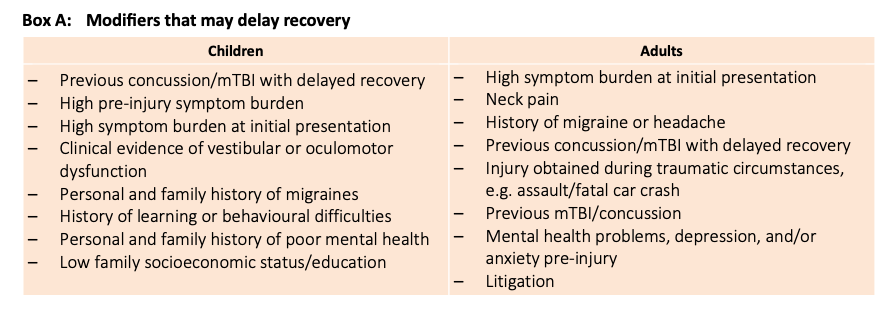
“For people at high risk of persisting symptoms (see Box A), qualified health care professionals should consider earlier referral to specialist services for post-concussive symptom management”

and states:

“The symptoms experienced by most people with mTBI/concussion resolve within 1 to 3 months of the injury but some people experience persisting symptoms and delayed recovery. People with mTBI/concussion who are at high risk for persisting symptoms or delayed recovery are more likely to require intervention than those at low risk. Early identification of these factors and their treatment may facilitate recovery.” 


Numerous potential modifiers that may predict delayed recovery are shown in the table below (Box A from Guideline 1)

However qualifying this recommendation, the source evidence also notes:

“However, no single factor is strongly predictive of outcome.” … and the elevated risk based on risk factors is both difficult to quantify and based on evidence of “varying strength”. 

Further, specifically in terms of risk of delayed recovery:

  • Repetitive head trauma and greater severity of symptoms at initial presentation have been associated with symptoms persisting for more than one month, although the vast majority of these patients recover by three months (Guideline 1)
  • “The severity of acute and subacute symptoms has been found as the most consistent predictor of slower recovery.” (Guideline 2)


From an ED perspective, whether alternative referral pathways to specialist concussion services (that bypass the GP) deemed to be at higher risk of delayed recovery would be beneficial remains unclear. Such early referral would also depend on availability of such services and their accepted referral criteria. The use of such prognostic criteria with limited predictive accuracy to initiate early referral at this very early stage in the ED could potentially: 

  • Unnecessarily create anxiety about a worse prognosis in patients in whom the individual likelihood of delayed recovery remains uncertain, and, in turn, potentially influence behaviour, mood or symptom perception.  
  • Overwhelm referral services by referring too many too early.
  • Yield limited overall patient benefit. Although a range of symptom-directed interventions are recommended for persisting post-concussive symptoms, evidence that these interventions accelerate overall symptom resolution remains limited. Additionally the magnitude of benefit from very early specialist referral, before persistent symptoms have actually developed, is uncertain. 


In general, the usual approach of initial GP follow up remains reasonable and in keeping with both practical resource management and the evidence base, although local guidelines and referral pathways should be considered. The GP may be guided by the above recommendations and criteria, in particular the severity of acute and sub-acute symptoms, regarding the need and timing for ongoing referral to specialist concussion services where available. Advice to the GP in the discharge letter may include such guidance in select patients. 

[Back to top – Contents]

Leave a Reply

Your email address will not be published. Required fields are marked *

Fill out this field
Fill out this field
Please enter a valid email address.
You need to agree with the terms to proceed

This site uses Akismet to reduce spam. Learn how your comment data is processed.